Growth Strategy Document

Crazy Cool Family

Architecture for Growth

A data-informed strategy for building a scalable, faith-based family connection brand — from one challenge to a durable platform.

Executive Summary

One Challenge. One Course. One Brand.

Crazy Cool Family has built something rare: a genuine, trusted voice in the faith-based parenting space, a proven speaker platform, and a body of content that has already changed households. The problem is not the product — it is the path. Awareness is low outside the speaking calendar, the portfolio is scattered across sub-brands, and there is no repeatable system to turn a first encounter into a paying customer.

This strategy solves that with a single, testable model: a free five-day Connection Challenge as the front door, and a $99 Connection Course as the first paid offer. Everything else — community, coaching, live events, a second course — waits behind proof that this model works. The six-month proof-of-concept budget is $100,000, weighted toward the two things that determine whether the model is real: demand creation and challenge-to-course conversion.

Section 01 — Who We’re Reaching

Target Audience Profile

The primary audience is Christian parents aged 26–50 who are intentionally pursuing deeper connection with their children. Research confirms a large, underserved market with strong digital engagement, consistent search behavior, and a clear preference for trust-based, outcome-oriented content.

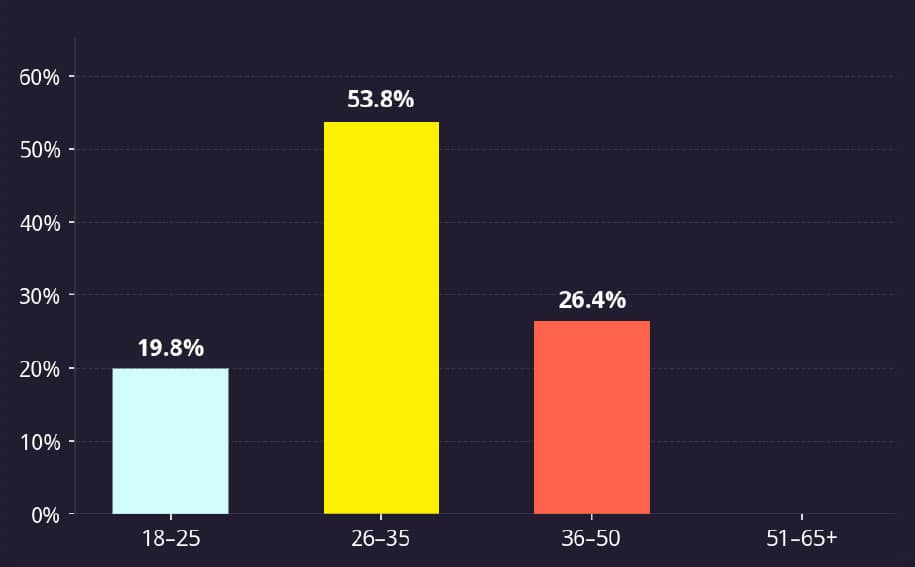
Audience Age Distribution

agodemo
Age distribution of the primary target audience.

Audience Gender Split

gendersplit 3
Gender split of the primary target audience.
The audience skews female (61%) and is concentrated in the 26–35 age bracket (53.8%), with a strong secondary cohort in the 36–50 range (26.4%). This is a digitally active, mid-life parent demographic that responds to experiential, relationship-centered content.

Household Income Distribution

householdincome 1
Household income breakdown of the target audience.
The majority of the audience falls in the $45,000–$100,000 household income range (69.9% combined), making a $99 price point highly accessible. The 12% in the $100K–$250K bracket represents a natural upsell cohort for future coaching and premium tiers.

The Market Is Large.
The Door Is Open.

The faith-based parenting category is a well-defined, measurable market with consistent year-over-year demand. The numbers below represent the estimated addressable audience and commercial opportunity in the United States alone.

16.7M–23.3M

Estimated U.S. Addressable Audience

$426M–$574M

Estimated Total Market Value

~1% YoY

Consistent Year-Over-Year Growth

Geographic Concentration — Top 10 States

top10states
Percentage of total addressable audience by state.
California, Texas, New York, and Florida together account for nearly 40% of the addressable audience. This concentration informs both paid media geo-targeting and partnership priorities, particularly for live event expansion in Phase Two.

Section 02 — Digital Landscape

Where the Audience Lives Online

Platform Affinity — Top 8 Channels

platformchannels
Affinity index vs. U.S. general population. 100 = average. Values below 100 indicate the audience under-indexes on that platform relative to the general population.
YouTube (91) and Facebook (80) are the strongest platforms for this audience, though both under-index against the general U.S. population — confirming this is a niche, trust-driven community rather than a mass-media audience. Instagram (68) and Reddit (71) represent meaningful secondary channels for community-building and organic discovery.

Top AI Prompt Topics by Affinity

topaiprompts
Audience affinity score for AI search prompt categories. Higher scores indicate stronger alignment with the target audience.
The audience’s AI search behavior reveals a clear hierarchy of intent: Christian Parenting Strategies (95) and Raising Emotionally Healthy Kids (83) dominate, confirming that the Connection Challenge topic set maps directly to the highest-affinity search behaviors in the category.

High-Affinity Keywords — Volume vs. Affinity

highaffinitykeywords 1

Each bubble represents a keyword. Bubble size = CPC. Each bubble represents a keyword. Bubble size = CPC. Yellow = niche monthly search volume (<500). Coral = breakout volume (12,000+). Affinity score reflects alignment with the target audience.

The keyword cluster in the upper-left quadrant — high affinity, low volume, low CPC — represents the sweet spot for paid acquisition: highly targeted, affordable, and deeply aligned with the audience’s stated needs. The outlier “how to study bible” (12,000 monthly searches) signals a broader awareness opportunity but at higher cost and lower conversion intent.

Section 03 — Competitive Landscape

Focus on the Family Owns the Category. The Door Is Open.

The podcast landscape is dominated by Focus on the Family properties, which collectively hold the top affinity positions. However, the category is not closed — it is underserved at the experiential, challenge-based layer. No competitor has built a free-plus-paid challenge funnel specifically designed for parent-child connection.

Top Podcasts by Audience Affinity

podcasts
Audience affinity scores for the top podcasts in the faith-based parenting category.

Hidden Gem Websites — Affinity vs. Monthly Traffic

hiddengem
Each bubble represents a website. Bubble size = relative monthly traffic. Sites in the upper-left represent high-affinity, lower-traffic partnership opportunities.
Christianparenting.org (83 affinity, 6,192 monthly traffic) and connectedfamilies.org (73.9, 8,614) represent high-affinity, low-competition partnership and advertising opportunities. Familylife.com (73.1, 48,574) offers broader reach with slightly lower audience alignment.

Top Online Communities by Audience Affinity

onlinecommunities
Reddit community affinity scores and member counts. Higher affinity = stronger alignment with the Crazy Cool Family target audience.
r/Parenting (8.26M members, 88 affinity) is the dominant community, but r/Mommit (2.73M, 85) and r/daddit (1.95M, 82) offer more targeted reach with strong gender-specific alignment to the challenge’s dual-track design.

Section 04 — Brand Identity

What a Crazy Cool Family Is

The brand requires simplification, modernization, and a single visual identity built around one name. Macy leads on camera. Don and Suzanne hold authority positions. The voice is plain, warm, and outcome-first — never preachy, never clinical.

This strategy solves that with a single, testable model: a free five-day Connection Challenge as the front door, and a $99 Connection Course as the first paid offer. Everything else — community, coaching, live events, a second course — waits behind proof that this model works. The six-month proof-of-concept budget is $100,000, weighted toward the two things that determine whether the model is real: demand creation and challenge-to-course conversion.

“A Crazy Cool Family is any family that loves each other and is intentionally pursuing connection.”

Core Brand Identity Statement

Brand Attributes

The brand is defined by connection as the primary value, with the parent-child relationship at its center. Home is positioned as a haven — a place of encouragement over criticism, where discipline draws parent and child together rather than apart. The brand celebrates differences within families, models faith through example rather than instruction, and aims to equip children to make wise decisions independently as they grow.

The visual identity should reflect this warmth: real family photography, a modern and uncluttered layout, and a color system that feels energetic but grounded. Legacy sub-brands should be gradually consolidated under the single Crazy Cool Family name.

Section 05 — The Strategy

Phase One: Prove the Model

The entire Phase One strategy reduces to three validation questions: Can the team affordably acquire challenge participants? Do participants complete the challenge? Do completers convert into course buyers? Everything else is downstream of those answers.

The Core Funnel

The Five-Day Challenge Arc

Section 06 — Investment

$100,000 Proof-of-Concept Budget

The budget is weighted toward the two things that determine whether the model proves out: demand creation (because awareness is the binding constraint) and the quality of the challenge-to-course experience (because conversion is the hypothesis being tested).

$36,000

Paid Media: Awareness & Challenge Acquisition
($3,000/month over 12 months)

$28,000

Connection Course Production & Platform

$14,000

Challenge Build & Evergreen Automation

$8,000

Second-Generation Content Production

$8,000

Brand Simplification & Modernization

$6,000

Tim Hawkins Collaboration & Partner Tests

Section 07 — Execution Roadmap

Six-Month Roadmap

The budget is weighted toward the two things that determine whether the model proves out: demand creation (because awareness is the binding constraint) and the quality of the challenge-to-course experience (because conversion is the hypothesis being tested).
Phase
Timing
Focus
Build
Months 1–2
Tracking infrastructure live. Macy's on-camera scope and compensation defined. Sibling podcast and testimonial sessions scheduled. Challenge content produced from the delivered family actions, hosted by Macy. Modernized brand identity developed and applied to the funnel path. Tim Hawkins asset recorded if partnership lands. Course production underway.
Soft Launch
Month 3
Challenge opens to the existing 9,000 subscribers and to the first committed monthly events. Trail Life/Man Alive appearances become live tests of the dad variant and event-to-challenge conversion. Early completion and assessment data flows.
Full Launch
Month 4
Paid media on. Tim Hawkins asset deployed if the partnership landed; first influencer partner tests run either way. Connection Course opens at $99 behind the challenge offer window.
Improve & Decide
Months 5–6
Tune the offer window, scale winning creative, begin redirecting Playbook and Basecamp traffic into the challenge. Month Six: formal review of the validation metrics and a go decision on expansion paths.

Section 08 — Performance Metrics

Validation Targets

A proof of concept needs pass marks defined before launch. These are the working targets; they will be pressure-tested together before the build phase locks them in.
Validation Area
Metric
Working Target
Acquisition Cost
Cost per challenge signup (paid media)
Under $5 to $8 per signup; near zero via events and partnerships
Challenge Completion
Five-day completion rate
40% or better — well above what typical email courses achieve
Purchase Conversion
Challenge-to-course conversion in the offer window
3 to 7% in early cohorts, improving with offer-window tuning
Impact in Homes
Before-and-after assessment movement; documented parent actions
The headline mission metric: parents visibly doing the material
Unit Economics
Blended cost per course sale vs. $99 price
A clear path to acquisition cost meaningfully below revenue per buyer
Community Demand
Waitlist take rate among course completers
A demand signal that informs the go decision and pricing for the paid alumni community
The fourth row — Impact in Homes — deserves special emphasis. The frustration that opened this engagement was that nobody does anything with the content. The assessment data answers that frustration directly, and it doubles as a marketing asset: real parents with real measured movement become the testimonials that lower acquisition costs in every later phase.

Months 13–24:
What Comes Next

Nothing below is funded in Phase One, and that is deliberate. Each path becomes a low-risk decision once the specific evidence that justifies it exists. This is how the concept, once proven, becomes a durable and growing platform.

Paid Alumni Community

Unlocked by: Strong waitlist take rate among course completers. A members-only space with monthly themes, AI companion access, and recurring founder sessions.

Coaching or Cohort Tier ($299–$499)

Unlocked by: Strong assessment movement and expressed appetite for more depth. Monetizes the trust the course has built.

Paid Webinars & Workshops

Unlocked by: Recurring topic demand visible in AI companion questions and community discussions. Single-session live experiences at low founder load.

Live Events & Family Intensives

Unlocked by: A proven funnel that gives live audiences a next step. Converts Don and Suzanne’s speaking strength into owned events.

Small-Group Facilitator Program

Unlocked by: Church distribution demand plus a bench of engaged alumni. Scales the ministry without adding founder hours.

Price Testing Above $99

Unlocked by: Consistent challenge volume, allowing a clean A/B test of $129 or $149 against the launch price. Data replaces assumption.

Alumni Challenges & Seasonal Experiences

Unlocked by: Strong completion and re-engagement rates. Short paid challenges keep the habit loop alive between bigger purchases.

Deeper Connection & Family System Curriculum

Unlocked by: Completer data showing appetite for depth. Don has already signaled eagerness to build the connection material out significantly.

Prepared for Crazy Cool Family · Confidential

© 2026 AMPED. All rights reserved.
AMP Logo AMPED white scaled